1942
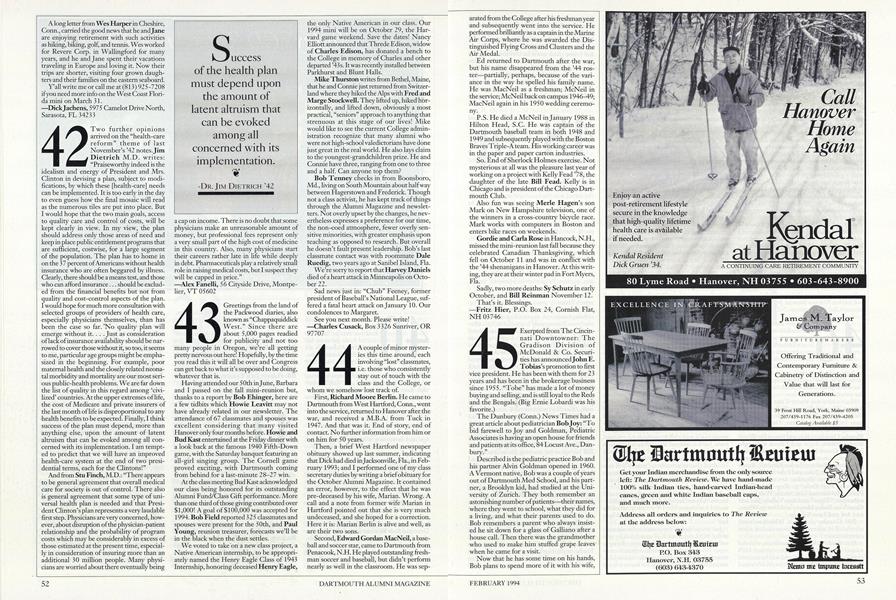
Two further opinions arrived on the "health-care reform" theme of last November's '42 notes. Jim Dietrich M.D. writes: "Praiseworthy indeed is the idealism and energy of President and Mrs. Clinton in devising a plan, subject to modifications, by which these [health-care] needs can be implemented. It is too early in the day to even guess how the final mosaic will read as the numerous tiles are put into place. But I would hope that the two main goals, access to quality care and control of costs, will be kept clearly in view. In my view, the plan should address only those areas of need and keep in place public entidement programs that are sufficient, costwise, for a large segment of the population. The plan has to home in on the 37 percent of Americans without health insurance who are often beggared by illness. Clearly, there should be a means test, and those who can afford insurance... should be excluded from the financial benefits but not from quality and cost-control aspects of the plan. I would hope for much more consultation with selected groups of providers of health care, especially physicians themselves, than has been the case so far. "No quality plan will emerge without it. . . . Just as consideration of lack of insurance availability should be narrowed to cover those without it, so too, it seems to me, particular age groups might be emphasized in the beginning. For example, poor maternal health and the closely related neonatal morbidity and mortality are our most serious public-health problems. We are far down the list of quality in this regard among 'civilized' countries. At the upper extremes of life, the cost of Medicare and private insurers of the last month of life is disproportional to any health benefits to be expected. Finally, I think success of the plan must depend, more than anything else, upon the amount of latent altruism that can be evoked among all concerned with its implementation. I am tempted to predict that we will have an improved health-care system at the end of two presidential terms, each for the Clintons!"
And from Stu Finch, M.D.: "There appears to be general agreement that overall medical care for society is out of control. There also is general agreement that some type of universal health plan is needed and that President Clinton's plan represents a very laudable first step. Physicians are very concerned, however, about disruption of the physician-patient relationship and the probability of program costs which may be considerably in excess of those estimated at the present time, especially in consideration of insuring more than an additional 30 million people. Many physicians are worried about there eventually being a cap on income. There is no doubt that some physicians make an unreasonable amount of money, but professional fees represent only a very small part of the high cost of medicine in this country. Also, many physicians start their careers rather late in life while deeply in debt. Pharmaceuticals play a relatively small role in raising medical costs, but I suspect they will be capped in price."
56 Cityside Drive, Montpelier, VT U3602
Success of the health plan must depend upon the amount of latent altruism that can be evoked among all concerned with its implementation. DR. JIM DIETRICH '42
More From This Issue
-
 Feature
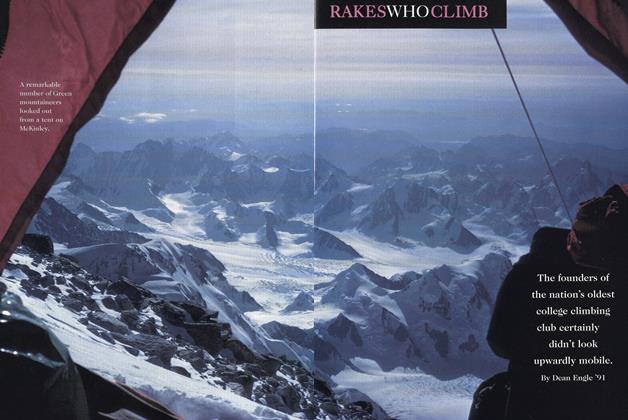
RAKES WHO CLIMB
February 1994 -
 Feature
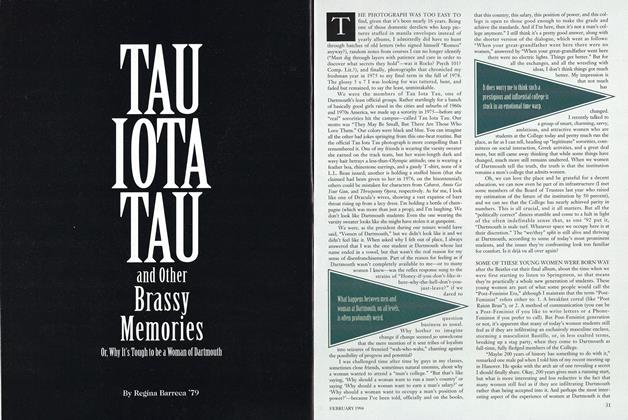
Tau Iota Tau and Other Brassy Memories
February 1994 -
 Cover Story
A leading poet argues that, whether consciously or unconsciously, we all breathe art's air.
February 1994 -
 Feature
ONCE UPON A CRIME
February 1994 -
 Feature
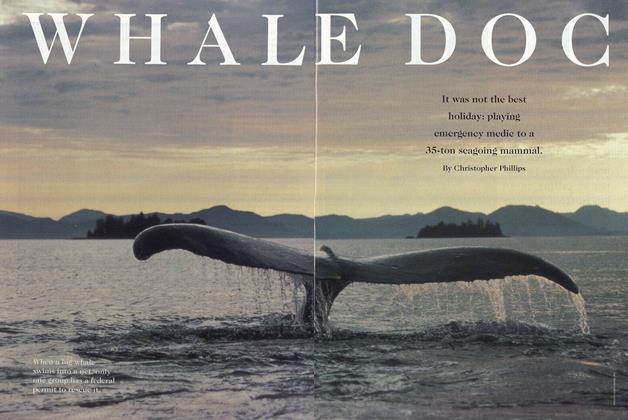
WHALE DOG
February 1994 -
 Article
Dr. WHEELOCK'S JOURNAL
February 1994