Corps Values
Dartmouth serves almost as a farm team for the Peace Corps: More than 500 alumni have volunteered during the organization’s 46-year history.
Dartmouth serves almost as a farm team for the Peace Corps: More than 500 alumni have volunteered during the organization’s 46-year history.
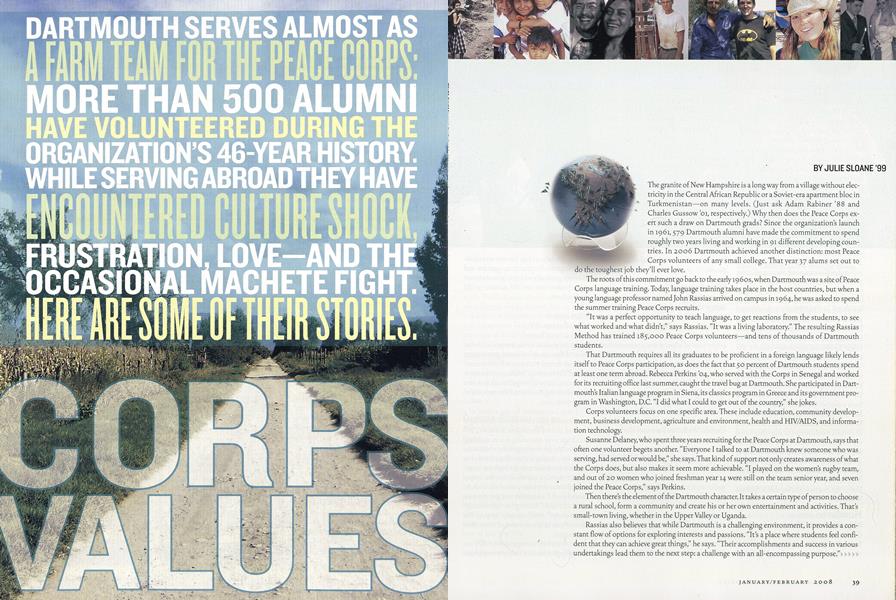
DARTMOUTH SERVES ALMOST AS A FARM TEAM FOR THE PEACE CORPS: MORE THAN 500 ALUMNI HAVE VOLUNTEERED DURING THE ORGANIZATION'S 46-YEAR HISTORY. WHILE SERVING ABROAD THEY HAVE FRUSTRATION, LOVE-AND THEORGANIZATION'S 46-YEAR HISTORY. WHILE SERVING ABROAD THEY HAVE ENCOUNTERED CULTURE SHOCK, FRUSTRATION, LOVE-AND THE OCCASIONAL MACHETE FIGHT. HERE ARE SOME OF THEIR STORIES.
The granite of New Hampshire is a long way from a village without electricity in the Central African Republic or a Soviet-era apartment bloc in Turkmenistan—on many levels. (Just ask Adam Rabiner '88 and Charles Gussow '01, respectively.) Why then does the Peace Corps exert such a draw on Dartmouth grads? Since the organizations launch in 1961,579 Dartmouth alumni have made the commitment to spend roughly two years living and working in 91 different developing countries. In 2006 Dartmouth achieved another distinction: most Peace Corps volunteers of any small college. That year 37 alums set out to do the toughest job they'll ever love.
The roots of this commitment go back to the early 1960s, when Dartmouth was a site of Peace Corps language training. Today, language training takes place in the host countries, but when a young language professor named John Rassias arrived on campus in 1964, he was asked to spend the summer training Peace Corps recruits.
"It was a perfect opportunity to teach language, to get reactions from the students, to see what worked and what didn't," says Rassias. "It was a living laboratory." The resulting Rassias Method has trained 185,000 Peace Corps volunteers—and tens of thousands of Dartmouth students.
That Dartmouth requires all its graduates to be proficient in a foreign language likely lends itself to Peace Corps participation, as does the fact that 50 percent of Dartmouth students spend at least one term abroad. Rebecca Perkins '04, who served with the Corps in Senegal and worked for its recruiting office last summer, caught the travel bug at Dartmouth. She participated in Dartmouths Italian language program in Siena, its classics program in Greece and its government program in Washington, D.C. "I did what I could to get out of the country," she jokes.
Corps volunteers focus on one specific area. These include education, community development, business development, agriculture and environment, health and HIV/AIDS, and information technology.
Susanne Delaney, who spent three years recruiting for the Peace Corps at Dartmouth, says that often one volunteer begets another. "Everyone I talked to at Dartmouth knew someone who was serving, had served or would be," she says. That kind of support not only creates awareness of what the Corps does, but also makes it seem more achievable. "I played on the women's rugby team, and out of 20 women who joined freshman year 14 were still on the team senior year, and seven joined the Peace Corps," says Perkins.
Then there's the element of the Dartmouth character. It takes a certain type of person to choose a rural school, form a community and create his or her own entertainment and activities. That's small-town living, whether in the Upper Valley or Uganda.
Rassias also believes that while Dartmouth is a challenging environment, it provides a constant flow of options for exploring interests and passions. "It's a place where students feel confident that they can achieve great things," he says. "Their accomplishments and success in various undertakings lead them to the next step: a challenge with an all-encompassing purpose."
Mauritania 1982-85
David Farley '81
History major
I was driving a motorcycle back to my village after visiting another volunteer 150 kilometers away. Bouncing on dusty dirt roads, one of the zippers on my backpack broke and my wallet fell out. In it I had photos of my family and my Peace Corps ID, which functioned as my de facto identity card. I had just cashed a paycheck, so it also contained about $300 in cash. After five or 10 miles I realized it was gone and circled back, searching for an hour or two. Nothing. All I could do was report it missing at a regional police station and go home to my village. I was really distressed.
A month later I got a message from the regional police station 18 kilometers away. Someone said, "The police want to talk to you. They have your wallet." Sure enough, I went to the police station and they pulled out my wallet, which still had my identity card and my pictures. The money wasn't in it, but I was so thankful. A village woman had found my wallet and turned it in. Then the police officer handed me my money—all of it. The police were just holding it in a safe place.
I drove out to thank this woman. She was an older lady living in a mud brick house in this poverty-stricken village. She probably lived on $1 a day, so $300 would have been a jackpot for her. In todays money it had the equivalent buying power of $2,000. In the United States what are the chances somebody would return $2,000 they found on the street? People there were devout Muslims and very good people. I ended up giving the woman all the money. I told her clearly God wanted her to have it. I was really touched.
Farley is an environmental engineer in Spokane,Washington.
Honduras 1988-91
Mike Grisham '88
Government
I went through a bout of dengue fever, sometimes called "break bone fever." It's transmitted by mosquitoes. It felt like a guy crawled in my ear and was pounding out my eyeballs with sledgehammers. My bones hurt—every inch of my body was killing me. When I got it, I was alone in my town. I was just delirious. I had no idea what to do. Someone summoned a doctor, who barged into my house saying something like, "Stand back! I work for the government!" Doctors there at the time loved injections, so he took out this enormous needle and plunged it into my body. I don't know what he gave me, but it turned out I was allergic to it. I then had to get on a bus and stumble into the capital with a 105-degree fever. Mom didn't hear about that until it was completely resolved.
Grisham works as an attorney in Anchorage,Alaska.
Nicaragua 2005-present
Sarah Fierce '04
Biology
I'm an environmental education volunteer and my job is to work with teachers and students in three primary schools. Poverty is at the root of a lot of the environmental problems. Nicaragua still has untouched rainforest and it's tempting to cut down that wood and sell it or use it for cooking fires. There's still a lot here to protect and that's our goal. I live on the Pacific coast, where there's a lot of mangrove forest. People cut down the trees for firewood and overfish the waters. They're completely exploiting the resources. While I've been here the government ministry that deals with the environment passed a law banning anyone from taking anything out of the mangrove forest. That started a riot in my town because people here are so dependent on those resources. It's the only income they have. Being here has opened my eyes to see that there is no easy solution.
Most adults can't see beyond their economic realities. I'm part of the push to start with kids, who are more open, and build up a consciousness about the environment. They get really excited about anything involving animals, so I do lessons on endangered animals. We plant trees, garden and make compost piles. I try to give them another perspective on the natural world around them.
Iran 1969-71
Larry Fabian '67
Math and Social Sciences
I was a city planner for the ministry of the interior of his majesty's imperial government. The term for city planning in Persian translates to "city building." While city planners in the United States fight legal battles over land use and zoning, I really had the authority to shape these cities.
I was summoned by the mayor of a small town to plan a new road. A main highway had skirted the edge of his town, and buildings were spreading out in one strip along it. My job was to give the town some width by creating an arc-shaped street to loop from one point in the highway to another. I wasn't a surveyor, but the mayor wanted me to mark the path of the road. So I paced it off. I remember one guy came up to me and said, "You've gone right through my property!" And I replied, "Be glad. The value of your land just went up!" He walked away happy.
I met my wife during that time. She was taking English lessons from my roommate. We lived in Iran for eight and a half years before moving to Boston. When people in Boston would describe a building from the 18th century as historic, we would chuckle. In the Middle East it would have to be a couple millennia old to deserve that. In Iran if you didn't see mountains in the distance, its only because you were on the mountain. The contours of the land are all worn down by history. Cities were pedestrian-oriented and many streets weren't wide enough for a car. You just feel the ancientness of it. An experience like that makes you aware of the vastness and the impact of history.
Fabian is an urban transportation consultant inBoston.
Guinea-Bissau 1996-98
Amy Staehr Carey '96
English
I taught English at the local high school and the majority of my students were male. If girls were even going to school, that was huge. In the end I think a lot of the impact I had in the town came from being a 21-year-old woman who had a job and didn't have babies or a husband. Simply by being there I was able to show that there are other options when it comes to choosing how to live your life.
When I was a guest anywhere in my village I was always put with the men. The men do a lot of hanging around and talking and drinking and playing games while the women do a lot of the work. Men treated me with a lot of respect but not really as an equal. They just weren't completely comfortable around me. It's hard to know what to do with a white female foreigner. I got a lot of marriage proposals!
When I tried to be a part of the women's world it was clear that didn't work either. I hadn't pounded rice my whole life, so my efforts slowed them down rather than helped. There was a family with whom I ate sometimes and the two wives of that family were the only real female friends I had, but our relationships were very different from the kinds of friendships I have with Americans.
Carey is a public health emergency response coordinator for the Berkshire County Boards of HealthAssociation in Lee, Massachusetts.
Bulgaria 2005-present
Andrew Hamilton '04
Anthropology
I knew I wanted to be a Peace Corps volunteer when I was 6 years old and used to wake up early on Saturday mornings to watch cartoons. In those days the Peace Corps ran very simple commercials, so simple, in fact, that I remember only the punchline: "Peace Corps: The toughest job you'll ever love." I have learned what tough means in these two years. But that was something I expected. I learned that the second part of the slogan was more important.
I've learned what it means to love. To love a job, to love a place and to love people. Sure, my job teaching English is infuriating at times, so much so I would have done anything to not go to work some days. Sure, my city, Bobov dol, has made me angry sometimes. People here have made me mad enough to question my hope for people. But I've learned to love them despite all these things.
All these bad things don't make you love less, they make you love more. It is easy to love something that provides no resistance, something that welcomes your love. It is so much harder to love something that acts like it doesn't need or want you—even sometimes acts like it hates you. If you can persevere and love it despite this, your love will grow stronger. I thought this job would be tough because I would love it and put my whole heart into it, but I never expected I would love it because it was so tough.
Thank you, Bobov dol, for teaching me love. And thank you for being so tough.
Hamilton teaches English at the American University in Bulgaria.
Ukraine 2003-05
Susan Crangle Vdovichenko '01
Linguistics
Before I left home I'd joked with my friends, "I'm not leaving the Ukraine without a husband." It was definitely a joke, but I had to eat my words. My future husband, Sergei, had been working with Americans on some translation projects, so when I got there the other Peace Corps volunteers introduced us.
Our wedding was really fun. In the Ukraine wedding ceremonies last about 15 minutes. The real emphasis is on having a good time at the party. And there's no pressure to have the perfect bridesmaids dress and match it to the flowers. Thinking like a hyper-organized American I tried to plan everything three or four months in advance, but people thought I was crazy. Ukrainian weddings are often thrown together in two weeks.
Even though people in our area spoke Russian day-to-day, our wedding ceremony was in Ukrainian. I couldn't understand a thing, but Sergei told me to do what he did. I'm not sure what I promised to do in our vows. There was a pregnant pause and I said, "Okay, yes."
For our reception we went to a restaurant where there was more food and alcohol than you can imagine. We played all sorts of stupid games, as if it were a junior high dance. There was a clown who organized all of it. He held a contest to see who could mummify somebody in toilet paper the fastest. Traditionally, someone steals the brides shoe and the best man has to do something to get it back. Sergei's best man had to do a strip tease. My favorite part of the whole thing was when the clown gave some girls balloons topped with shaving cream and they had to shave them as fast as possible. As soon as he said "go," he poked all the balloons with a pin. Shaving cream went everywhere. None of these people had washing machines—later they were going to have to scrub their clothes by hand—but everyone was laughing. Americans take their weddings so Seriously, but ours was just silly and fun.
Vdovichenko is a graduate student in Slavic linguistics at Ohio State.
Bolivia 2006-present
Erin Bingham '05
Spanish Literature
When I first arrived in Bolivia I lived in a town called Chimeo. There was one family that I became close to there. The father, Cecilio, was a member of the beekeeping association I worked with. Cecilio, his wife, Ana, their four children and I all took a day to go out into the woods and check the family's bee boxes, make lunch and spend time together.
We strapped everything into a few wheel-barrows and hiked about 10 kilometers into the jungle. That was the first time the Bolivians' resourcefulness became apparent to me. Ana picked up some long branches from the ground, tied leaves to them and fashioned a broom for each of us. We swept up all the leaves and the cow patties until there was a spotless dirt area for us to set up a table and start cutting vegetables for lunch. Meanwhile Cecilio and his sons went looking for discarded planks of wood, which they used to make a chair for each of us.
Next came the water dilemma: There wasn't any. Ana, Cecilio and I hiked down the mountain and along the dry riverbed until we came to a muddy part in the river. Ana and Cecilio dug at the river wall, removing mud and waiting for the water to trickle down. In a couple of hours we had filled three buckets with dirty river water. In the most inoffensive tone I could muster, I asked them if we were really going to drink that black water. "Yes," they said, "but don't worry, we'll clean it." Again their resourcefulness surprised me. Their eldest son found a few cactus branches, cut them into 2-inch pieces of white flesh and threw them into the buckets. Thirty minutes later the chunks of cactus were black and thewater was clear. We spent the rest of the afternoon cooking, working with bees, talking, drinking mate and going on short hikes through the jungle, admiring the monkeys, toucans and parrots. It's amazing what a festive occasion they could create using the natural world around them.
Turkmenistan 2002-04
Charles Gussow '01
History and Anthropology When I tell people that I lived in a Stalinist dictatorship, I am being both strictly accurate and unfairly negative. Turkmenistan was run by President Sapamurat "Turkmenbashi" Niyazovwith Cult-of-personality flair until his death in 2006. Entering the country I was greeted by both the presidents face smiling down from a wall mural and glares from well-armed KGB agents supervising the customs hall of the airport. Yet this jarring arrival did not convey the warmth of the Turkmen people or their genius for creating normal lives in the midst of uncertainty.
I lived in Balkanabar, an oil town in the high desert. I taught English to Russian-speaking students, many descended from the gulag laborers who founded the city. Our government-approved curriculum focused on the spiritual guidebook written by the president. As Turkmenbashi's oeuvre was outside my expertise, I taught geography and critical thinking skills. When officials visited my class local colleagues and I would strain all bounds of logic to explain how the lesson fit into the official curriculum.
Outside of work my community was both parochial and welcoming. One friend kept his Soviet-era guidebook for surviving nuclear war with the United States close at hand while hosting American volunteers for dinner. Another counted the hours to the end of Ramadan, so we could share a bottle of vodka and pork kebabs. All were delighted that a foreigner would bother to live among them and learn about their culture. When Turkmenbashi's name was mentioned, they would say, "Lets not talk politics. Let's discuss friendship."
Gussow works as a program assistant for the Billand Melinda Gates Foundation in Seattle.
Honduras 1980-82
Ellen Meyer Shorb '78
History and Women's Studies
When I first arrived in Honduras it felt like camping. It was physically different and dusty hot. Before long that environment became normal. What began to stand out was the drama of peoples' lives. I began to know babies who died. The brother in my host family beat his wife. Two guys got in a machete fight and one died. You know about love affairs or when two people don't get along. I lived with a family, and the father, who had kids in the village by different women, left his wife and their children for a year. One day I was sitting in their kitchen when he walked in. After all that time away he just walked in, poured himself some coffee, spit it out on the kitchen floor and said, "Muy amargo" (very bitter). I was stunned, but my Honduran mother didn't blink. She was glad he was back.
I saw things we don't see in the United States because we have ambulances and hospitals and health care. When I was teaching one of my first-graders came to me and said, "Can I go home? My tooth hurts." He opened his mouth and the tooth looked raw. I told him to go home. Another time I was in church when a woman came in screaming wildly, obviously mentally ill. Two men grabbed her and took her out. I followed to make sure they weren't going to hurt her. They tied her to a beam with rope. When I approached her, she lunged at me. That's when I realized these people had no choice but to restrain her. She'd had medication but it ran out. We don't see mental illness gone wild like that in America. I was touched by how people live and realized most of the world lives this way. In some ways it's very much like us: the love, hard work, drama. In other ways it's rotten teeth and machete fights.
Shorb is a leadership consultant living in Lincoln,Massachusetts.
Slovakia 1995-96
Andy Elsbree '57
History
I was 59 and a half when I retired as the VP of a paper company. It was a relatively high-pressure job and I didn't think I could just walk off and do nothing. My wife, Carole, and I had never lived overseas. Our kids were all married and happy. Why not go do a little bit of good?
Slovakia at the time was just emerging from the communist realm. Slovaks were looking for people with business and teaching experience, and that was us.My job was to advise their equivalent of the Small Business Administration while Carole taught high school English. When we arrived it was obvious that Slovakia had not yet opened up. The former communist officials had been popped right into Western, democratic-style jobs. It was still commonly believed that if you don't steal from your company you're robbing your family. People were very quiet when they rode the streetcars because they didn't know who was listening.
I preached to the agency director that he needed to run meetings in a more open way to encourage people to share ideas. Everyone in the office kept their doors closed, so I encouraged him to make sure all doors stayed open. He did tell everyone to keep doors open. But he kept his shut. I worked with another government office that had split off from mine and I walked in and saw lots of young, attractive men and women, some Slovak-American. The director explained that he couldn't hire old folks because they can't think out of the box.
Carole's experience was much different. Her students were hungry to learn about the West and how things are different. When she asked her class how many had access to a computer, every hand went up—and these kids were poor. We knew the younger generation would make a world of difference. They saw or heard about what was going on an hour away in Vienna and they weren't going to let their country go back to what it was. We were in Slovakia a little early. I'm sure the office doors are open today.
Elsbree, now retired, lives in Sunriver, Oregon.
Guinea 2000-02
Annie Kneedler '00
Anthropology
In my small village in Guinea I worked to integrate environmental themes into their primary school curriculum. I also worked with farmers on new planting techniques and helped a women's group with a fruit-drying project.
I found everyone so welcoming. I ate dinner every night with the family next door, a mom and two little girls. They became like my second family. When I left, my village mom—who has only a fifth-grade education and can't read—opened up an e-mail account. She takes her small amounts of leftover money, goes to an Internet cafe in a nearby town and has someone type e-mails to me.
The experience defined for me what I wanted to do with my life. I spent the past two years as a consultant based in Ghana, helping farmers raise their quality standards in order to sell their mangos and pineapples on the international market. I just started business school to further that goal.
Had I not been in the Peace Corps I think my career in international development would have seemed too intimidating. But after fetching my water from a pump everyday and learning to speak two new languages, I figured I could probably handle anything.
Kneedler is an M.B.A. student at the University ofMichigan.
Moldova 1993-95
Shirley Ray, MALS '73
Our family lived in the Upper Valley for 15 years. We moved to Hanover the year JFK was killed in Dallas. Many were inspired by his call to serve, and Dartmouth had a Peace Corps office in the basement of the administration building. I had three young children at that time but I knew serving in the Peace Corps was something I had to do at some point. Feeling a little out of place with all of the youthful enthusiasm, I went down the crowded corridors and looked through the materials defining Peace Corps service throughout the world.
When I was 58 and decided to stop teaching school in Vermont, I applied. There were two countries to choose from: Poland, which I knew, and Moldova, which I had to look up. For hours in Baker Library I looked at maps of Moldova, and it looked like there might be a sliver of land on the Black Sea. The lady at the Peace Corps office assured me there was a seaport. I figured that was better than landlocked, cold Poland. As it turns out, Moldova is landlocked and cold too.
Our group of Peace Corps volunteers was the first in Moldova, and many there had never seen an American. Soviet domination had created a bleak and unhealthy country. My apartment, a farm extension from a large home, was in downtown Chisenau, close enough to parliament and the capitol that we had heat. That was a blessing. I could leave the frosted windows of the university and bring the students home. It was windy and bitterly cold. Nowhere was there potable water, and it took eight hours to filter a quart.
Yet I simply loved the people and the work. My assignment was teacher training at Moldova's only university. One of my secondary projects, with other volunteers, was an interdisciplinary intensive English language school, inspired by my participation in the MALS curriculum. The summer school continues.
Ray, now retired, lives in AnnArbor,Michigan.
Samoa 1975-77
David Gilmour '70
Anthropology
After medical school and an internship I served at a hospital in Apia, Western Samoa. It had fairly primitive conditions. The surgery suite was a single room. One nurses only job was to chase away the flies. It was certainly a unique experience. One day we heard a terrible crash. A kid was trying to pick mangos but reached too far and fell out of a tree right onto the roof of the hospital. Another time a fellow came in with the bill of a swordfish stuck in his chest. I got TB and dengue fever while I was there. Patients paid 50 cents to use the hospital, and they'd often bring gifts of food to my house.
In Samoan culture it's considered unusual to have a solitary existence. Their language doesn't even have words for "solitude" or "privacy." Those concepts are absolutely foreign. Going for a walk by yourself could be considered an offense.
I haven't been alone since 1975. Near the end of my stay there I married a Samoan woman, and we've been married for 30 years. We brought my wife's brother and sister to live near us and they brought their friends. Thanks to us there are now 300 Samoans living in southern Oregon.
Gilmour is a physician in Central Point, Oregon.
Mali 2004-07
Amelia Walling '04
History
I was a health education volunteer in a small village in rural Mali. We joked that Mali is always battling it out with Niger and Sierra Leone for the title of poorest country. It is one of the poorest countries on earth, but it has so much to offer.
If you're a woman in Mali you wake up when the sun rises and go to the well for a few buckets of water. I didn't have to cook or support a family but I did get my own water. That was something that helped me feel a part of the community. The wells in rural Mali are huge areas for gossip. At peak times there are 20 or 30 women. You greet everyone and ask about the health of their family members. If one gave birth or has a family member returned from another village there are appropriate things to say.
When I arrived the village chief came over, consulted with the old men around him and then said my name would be Kadidia Ongoiba. It's a lot easier for them to pronounce than my real name. At least half the village had Ongoiba as a last name. When my parents and brother came to visit they were also given local names.
Walling is a student at Duke Medical School.
Central African Republic
1888-89
Adam Rabiner '88
Religion modified with History One thinks stereotypically of the Peace Corps lifestyle as living in a remote thatched hut, no electricity or running water, very little communication with the outside world. That was pretty much my experience. No one in Maorka spoke English and I only gradually learned their language, Sango. The town had no telephone. To reach the nearest Peace Corps volunteer I would bike 12 kilometers.
My job was to work with the county's subsistence farmers to teach more advanced and sustainable beekeeping techniques. But the deck was really stacked against me. The biggest challenge was just finding beekeepers who wanted to learn. It wasn't a full-time job for any of them, and few were interested. The method I was teaching required the use of a smoker, but those weren't available in the CAR and nobody I met could manufacture one. I brought white clothing because bees tend to be pacified by the color white, but these people were so poor they couldn't afford new clothes for something that was at best a tertiary source of income. There also wasn't a real market for table honey. It was mostly used to make beer. People would bring me their honey because they thought I was there to buy it.
I didn't feel like I was achieving anything, and this sleepy village of 300 people who labored in the fields all day was often mind-numbingly boring. I decided to return to the United States after 10 months there. But the Peace Corps has played a big role in my life. I was president of the Corps' New York City alumni group, where I met my future wife, Dina, and many of our friends. My experience in the CAR was frustrating, but I'm glad I did it.
Rabiner is director of public-private internship initiatives for the New York City Department of Youthand Community Development.
Kyrgyzstan 2005-07
Anna Moschet '05
Government
I lived in a small town called Toktogul and taught English. By chance Erin Fifield '05 and I were placed in the same town. We didn't know each other at Dartmouth but we became pretty good friends. There's no pickup service for trash in the town so everyone burns it. During the time of Dartmouth's Homecoming we were feeling homesick, so we set fire to our trash and ran around it singing the alma mater. Some guy saw us and looked at us like we were crazy.
We got DAM, but we didn't burn those. They would go to the English resource center we started. We got a grant to rent out a little room in the center of town and stock it with bookcases and English books. The schools had really outdated materials and advanced students of English didn't have many outlets to improve. The students would ask us what it was like to go to university in America. It's hard to convey that, so we gave them Moschet now attending the University of Michigan law school.
Tunisia 1962-63, Gabon 1963-64 John Murphy '58
English
Having recently left the Marine Corps I was inspired by President Kennedy's inaugural address, 'Ask not what your country can do for you, ask what you can do for your country." My first assignment was as a physical education instructor in a boys' orphanage in Tunisia. I was assigned to work with Mohammed Fessi, a former weighlifting champion who didn't know anything about sports. When one of the boys in our class broke his wrist Mohammed's idea of treatment was to twist the wrist and tell the boy it was all right. I tapped Mohammed on the top of his head and told him to stop, and this act resulted in the man losing face in front of the boys. So he kicked me out.
Rather than play one-on-one basketball with the boys after they got out of classes for the remaining year of my service, I went to Tunis and requested an assignment to another orphanage. Instead, I was asked if I'd like to go to Gabon to take charge of a rural school construction crew. "Wonderful!" I said—then I rushed to a map to see where Gabon was.
After my nebulous assignment in Tunisia I welcomed the focused goal of school construction. I could speak French and so I worked with the Gabonese officials as sort of an expediter and helped to get the project off the ground. The remarkable result was that, in three years—the last two after I'd left—the Peace Corps had built 30 schools and 100 teachers' houses. Unlike the French colonials who bossed the Africans around, we got our hands dirty and were known as les blancs qui travaillent (white people who work).
Murphy is an attorney in Harford, Connecticut.
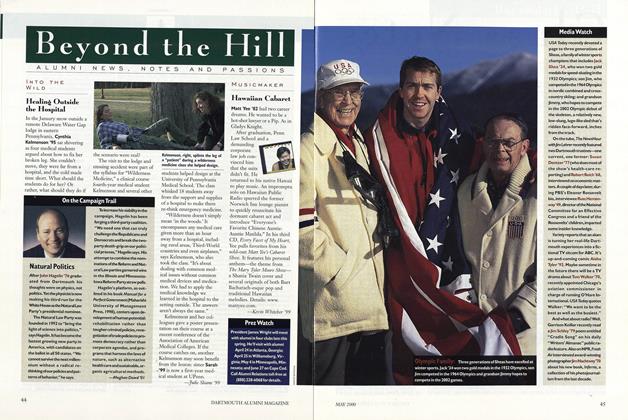
A Peace of the Action Sarah Fierce (left), stillserving, teaches students in Nicaragua. Charles Gussow (above, at right) takes an oasis breakwith a new friend near Nebit Dag in Turkmenistan.
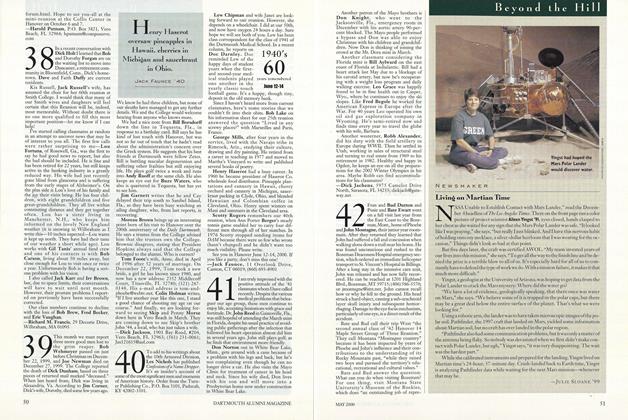
Alumni Abroad Numerous alums, including Ellen Meyer Shorb (above, with a young Honduran friend) are transformed by their Peace Corps experience.
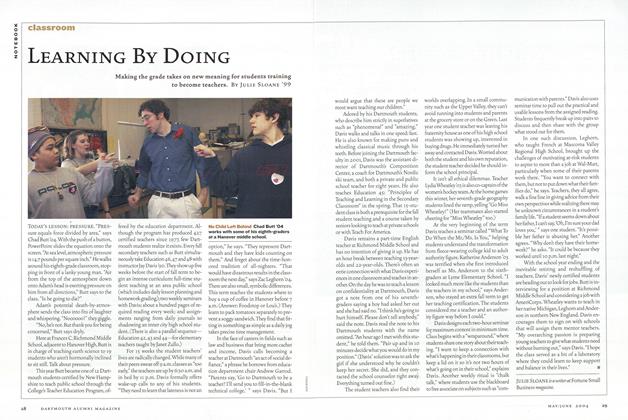
Outreach John Murphy worked with a crew to construct 10 schools in Gabon, where volunteers were referred to as les blancs qui travaillent (white people who work).
Year Number of alums Small colleges ranking entering Peace Corps
Julie Sloane writes frequently for DAM. Shelives in San Francisco.