1956
Doug Keare is Assistant Resident Representative in East Pakistan for the International Bank for Reconstruction and Development, better known as the World Bank. He has written a letter with views and opinions of considerable general interest.
"East Pakistan is made to order for a Man of La Mancha. You gotta have a heart, but all the dreaming—and hard work—in the world is extremely unlikely to make any 'impossible dreams' come true. East Bengal has been shat upon by nature since time immemorial, and this year's severe floods and disastrous cyclone and tidal bore are only timely cases in point. What is more, all of Bengal was more-or- less neglected under the British Raj and has been by mankind since. More recently the East Bengalis have been cruelly exploited by their Pakistani brethren in the West and have been the chief losers from the break in relations with India; which was not much of their doing.
"We came here from Malaysia in September and quickly found it to be a place where 'Murphy's Law' operates like an inexorable machine. Even things which can't possibly go wrong frequently do. Our sea freight sat in port during heavy monsoon rains for several days while everyone concerned outdid one another at doing nothing. Eventually, our belongings arrived very water-logged. And we are to date without a functioning telephone, registration for our car, etc., etc. And yet, we do exist—at times quite well. I manage to get to and from work, and the kids to and from school, most every day. Yesterday we didn't as there was a general strike or hartal. We live in a pleasant house with lovely garden and swimming pool, and the household runs despite the fact that our servant problem—there is always a 'servant problem'—isn't completely sorted out. The winter season (October through February) offers weather as fine as one ever sees anywhere and, even during the hot weather and the monsoon, we are spared pollution—of the air. The water is, of course, something else again. It can't be polluted further.
"As to what we are doing or attempting to do, The World Bank, my current employer, has undertaken to increase its lending to East Pakistan severalfold over the next few years and to attempt to persuade other aid donors to do likewise. This is a serious undertaking, and a comprehensive program for water and agricultural development has been worked out to this end; in addition, the recent cyclone has put the Bank back in the 'reconstruction' business in a fairly big way. An effort has been mounted to rehabilitate the stricken area, and hopefully will be extended to genuine (new) development in the near future. We are here to help refine these programs and see them through, but our work is cut out for us. The general reluctance of other donors, the incompetence of the Government of East Pakistan (Murphy's Law is operative here as well) and the only thinly concealed opposition of the outgoing Government at the Centre all work against us.
"Fortunately, the last factor is unlikely to be with us for long. The results of the recent elections were, if nothing else, a great victory for East Pakistan. Bhutto's success in the West remains a big question mark. And, in the end, the nation may not stay together. However, come what may, the East Pakistanis will be more-or-less in control of their own destiny. They will of course have to contend with their own shortcomings, but the biggest bugbear is likely to be the unconcern of the outside world—in particular, the inhospitable policies of the already developed world.
"I have been studying the problems of development and working in under-developed countries for almost ten years now—which has been long enough to convince me that a fair proportion of these countries are attempting to follow policies which are reasonably good for their people and would lead to a respectable development performance were it not for the 'lack of cooperation' of the developed world. We developed countries have sent out a fair number of talented and dedicated people and other resources, and these have done some good. At other times and still in some places these resources have been wasted. More recently, however, they are usually being put to good use and are accomplishing the desired results. Unfortunately, we have managed perversely to more than offset the good accomplished by sensible assistance policies by hewing to myopic and other idiotic trade policies.
"Contemplating the situation at home, I see many things which are discouraging— but few more so than the way our misguided foreign and commercial policies exacerbate the plight of the poorer countries struggling to develop. I practically have a seizure every time I think of the semi-sophisticated cretin in charge of the U. S. Department of Commerce who bungled trade negotiations with Japan, then opened up a Pandora's Box in a willing Congress by suggesting trade restrictions and since then has remained silent in face of the fact that his initiative has reversed the process toward greater trade liberalization and threatens to set off a major trade war—and this at a time when the 2/3 of mankind living in underdeveloped countries can only hope to solve their problems if they can rapidly expand trade. Needless to say, I am little calmed, when I read of the Nixon administration's pious plans to curtail 'wasteful' aid (but not military aid) and rely almost entirely on private sector development—without explaining what the private sector is going to develop if the countries can't export.
"Fortunately, Bengal offers an outlet When frustration at the lack of enlightenment and progress in such areas mounts to the danger level, we can turn to the local papers. These don't offer Peanuts or Pogo. but they do offer such as the following three separate examples: 'Following the reports (of a helicopter crash), ... officials rushed to the area with all arrangements for rescue and salvage operation, but to their utter disappointment they failed to find any basis for the claim.' 'The plane had the crash-landing for a brief stop over at Shamshernagar.' 'The condition of the three who were killed is improving.'
"I missed this flight by 24 hours."
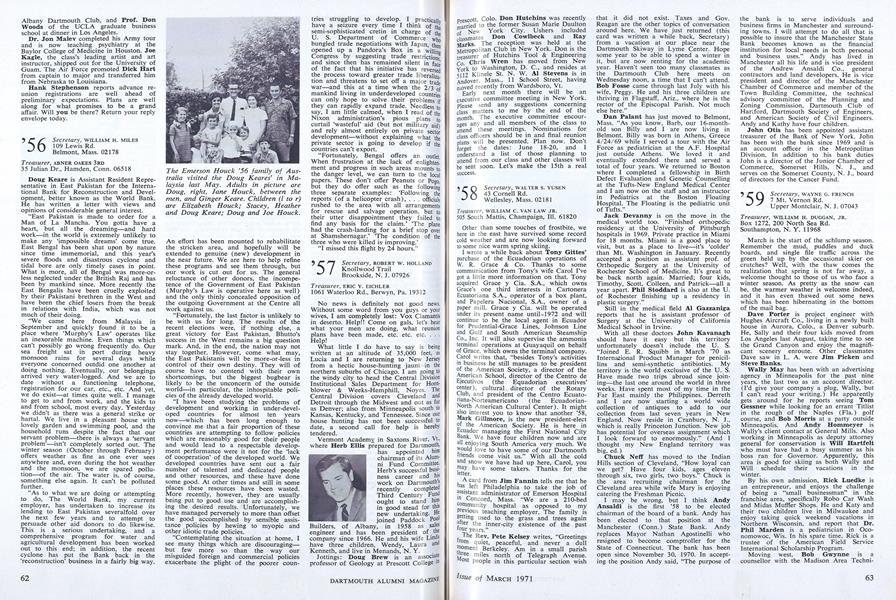
The Emerson Houck '56 family of Australia visited the Doug Keares' in Malaysia last May. Adults in picture areDoug, right, Jane Houck, between themen, and Ginger Keare. Children (l to r)are Elizabeth Houck; Stacey, Heatherand Doug Keare; Doug and Joe Houck.
Secretary, 109 Lewis Rd. Belmont, Mass. 02178
Treasurer, 35 Julian Dr., Hamden, Conn. 06518